Fact Sheet Display

846th Test Squadron


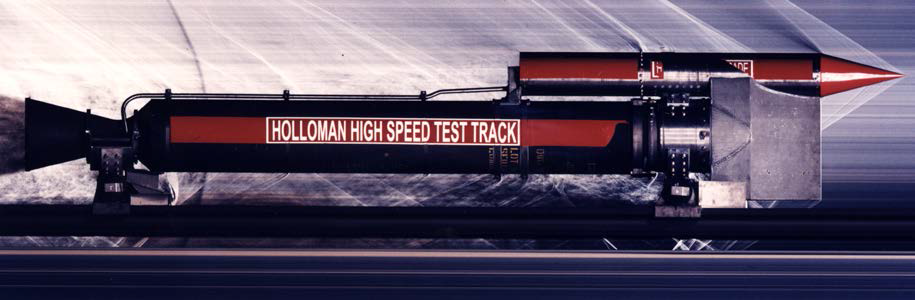
Operated by the 846th TS, the HHSTT is the world's premier rocket sled test track. The mission of the 846th TS is to plan and execute world-class rocket sled tests enabling critical weapon system development in support of the warfighter using world-class people, technical excellence, cost-effectiveness and agility.

At 59,971 feet, the HHSTT is the longest facility of its type in the world. Each of the three rails that form the track is continuously welded, in tension at temperatures below 120º F, and aligned to within 0.04 inches of intended position in the operational region of the track. The HHSTT serves as a critical link between laboratory-type investigations and full-scale flight tests by simulating selected portions of the flight environment under accurately programmed and instrumented conditions, often before flight-worthy hardware is available.

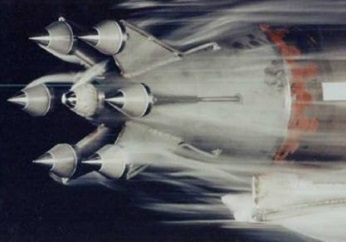
Test vehicles (sleds) are accelerated to mission velocities by means of solid rocket motors, frequently in multi-stage operation. Sled speeds in excess of 9,400 feet per second have been demonstrated in the past and the 846th TS is pursuing an on-going improvement program to achieve speeds in excess of 10,000 feet per second in support of future customer requirements. Sleds weighing up to 60,000 pounds have been used and heavier sleds can be operated if required. Depending on payload size, instantaneous accelerations of more than 200g have been demonstrated. For a wide range of test problems, the HHSTT provides and efficient, safe and cost-effective ground test alternative to expensive developmental flight tests.

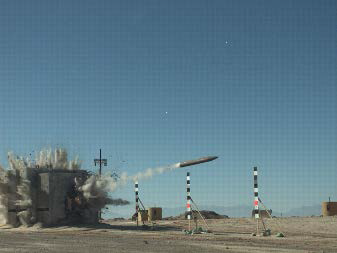
Complementing the Test Track itself, the overall HHSTT complex encompasses ancillary facilities for artificial rain simulation, an accurately surveyed ejection test area, captive and free-flight blast test sites, impact test sites and a horizontal rocket test stand. Support facilities include buildings for electronic and photo-optical instrumentation, a telemetry ground station and engineering and shop facilities for design and fabrication of test hardware.
                

Advantages of Rocket Sled Testing
Bridges the gap between laboratory and flight tests.
Allows full-scale high-fidelity testing.
Lower cost than flight testing.
Post-test recovery of test hardware.
Accurate/timely results, often higher quality than available through flight test.
Reduces technical risk and program cost.
Replicates the flight-test environment.


Test Capabilities
Hypersonic Velocity
Munitions: Hard Targets, Penetrator Effectiveness, Missile Defense, Fuzing, Dispenser, Seekers, Guidance, Warhead Lethality.
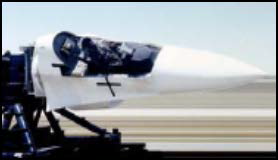
Crew Escape: Ejection Seats, Parachutes, Canopies, Vulnerability, Rocket Catapults and Ejection Seats and Safety & Survival Equipment.
Guidance Systems: Reference Measurement, Components and Full-Size Systems.
Directed Energy: Infrared Countermeasures, Target Tracking/Illumination and Atmospheric Effects.
Article Dispense: Weapons, Flares or Countermeasures.
Electronic Combat: Missile Warning Receivers, Countermeasures.
Environmental Effects: Rain/Ice/Particle, Aerothermal, High G, Explosive Blast.
Aerodynamics: Boundary Layer Transition, Launch into Flight.


Impact testing of warheads, seekers and fuzes; hard target and earth penetrators.

    
Weapons dispensers and missile launchers.

    
Simulated rain field or individual droplet impacts
Ice, dust and particle impacts; full-scale nosecones or multiple material samples

         
Full-up escape system evaluation.

    
Multi-Axis Seat Ejection Sled - One-of-a-kind sled capable of ejections
at +30º pitch, +20º yaw, +90º static roll or 360º per second dynamic roll.

Point of Contact
846th Test Squadron
575-679-2133 / DSN 349-2133
575-679-2766 / DSN 349-2766
Email: 846ts.info@us.af.mil

LANDING GEAR TEST FACILITY

Overview

The Landing Gear Test Facility (LGTF) has been a cornerstone of aerospace testing at Wright-Patterson Air Force Base since 1942, dedicated to ensuring the reliability and performance of aircraft landing gear systems.

Throughout its history, the LGTF has supported the warfighter by providing critical data to enhance the safety and effectiveness of landing gear, wheels, tires, and brakes, directly contributing to the mission of the United States Department of Defense. In addition to its military focus, the LGTF offers comprehensive testing services to commercial entities, employing world-unique test machines capable of simulating real-life conditions with unparalleled accuracy.

Guided by the core values of IntegrityService, and Excellence, the LGTF consistently delivers precise and dependable data to both military and commercial partners.

Test Machine Capabilities


 Overall System Specifications:

Max Speed: 250 mph
Max Acceleration: 21 ft/s2
Inertial Equivalent: 2,445 - 20,063 lbs.
Max Kinetic Energy: 41,750,000 ft-lbs.


South Carriage Specifications:

Max Load: 40,000 lbs.
Max Torque: 375,000 in-lbs.
Max Tire Size: 64 in


North Carriage Specifications:

Max Load: 25,000 lbs.
Max Torque: 72,000 in-lbs.
Max Tire Size: 48 in

Overall System Specifications:

Max Speed: 350 mph
Max Acceleration: 24 ft/s2

South Carriage Specifications:

Max Load: 150,000 lbs.
Max Yaw: ± 20°
Max Camber: ± 20°

North Carriage Specifications:

Max Load: 100,000 lbs.


Overall System Specifications:

Max Speed: 200 mph
Max Acceleration: 2 ft/s2
Inertial Equivalent: 10,147 - 162,987 lbs.
Max Kinetic Energy: 205,000,000 ft-lbs.

South Carriage Specifications:

Max Load: 301,500 lbs.
Max Brake Torque: 5,800,000 in-lbs.

Overall System Specifications:

Max Speed: 250 mph
Max Acceleration: 16 ft/s2
Max Vertical Load: 150,000 lbs.
Max Yaw: ± 20°
Max Camber: ± 10°

Overall System Specifications:

Max Compressive Load: 3,000,000 lbs.
Max Tension Load: 1,000,000 lbs.
Max Stroke: 60 in
Max Height: 28 ft
Max Width: 10 ft
Platen Size: 60.5 x 96 in

Overall System Specifications:

Max Vertical Load: 75,000 lbs.
Max Side Load: 30,000 lbs.
Max Yaw: ± 90°
Max Camber: ± 10°
Max Tire Size: 56 in.
Table Length: 20 ft.
Max Travel Speed: 3 in/s
Roll Distance: 217 in


Overall System Specifications:

Below-grade safety enclosure
Dimensions: 72 x 120 x 126 in.
Water Pressure Limit: 5,000 psi
Rate of Inflation: 10 psi/min

Drop Tower #1

Load Range: 750 - 3,600 lbs.
Wing Lift: 200 - 3,600 lbs.


Drop Tower #2

Load Range: 2,000 - 10,300 lbs.
Wing Lift: 200 - 10,300 lbs.


Drop Tower #3

Load Range: 6,500 - 50,000 lbs.
Wing Lift: 200 - 35,000 lbs.


Drop Tower #4

Load Range: 35,000 - 150,000 lbs.
Wing Lift: 200 - 150,000 lbs.

Load frame that accommodates multiple hydraulic cylinders to provide controlled forcing and operational stresses to test objects in all 6 axes.

Recent Articles

CONTACT US

704 TG/OL-ACL
Landing Gear Test Facility
1981 5th Street
Area B, Bldg. 31
Wright-Patterson AFB, OH 45433
(937) 255-9216
704.tg.olac@us.af.mil


WHERE TO FIND US

Contact Form

Contact Form

Reach out to us
You can enter up to 1000 characters

ContactFormDashboard

The template for this control has not been configured for use yet. You may change the template under the settings menu for this module.