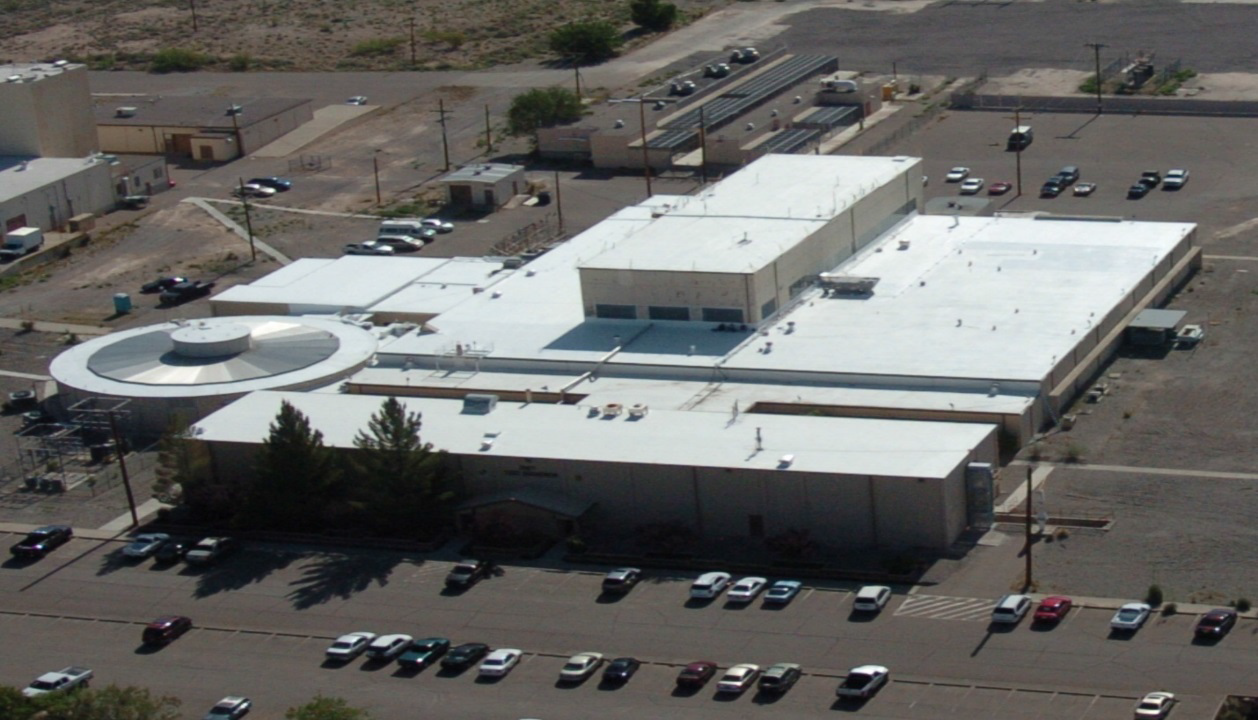
Mission
Provide superior test and evaluation of DoD guidance, navigation and NAVWAR systems in support of the warfighter.
Unique Capabilities
- Utilizes fully instrumented aircraft including the T-38C, C-12D, C-12J and UH-1
- Provides various low, medium and high dynamic operating environments for systems under test
- Validated truth reference providing position, velocity, attitude and timing
- Extensive range of environmental and inertial test beds to evaluate unit performance
The 746th Test Squadron (746 TS), also known as the Central Inertial and GPS Test Facility (CIGTF), has been the DoD's leader in guidance and navigation system testing for over 50 years. While the CIGTF's mission began with inertial guidance and navigation testing, the unit has since expanded its expertise to include GPS due to its success as a navigation aid. Today, the CIGTF is the established leader in inertial, GPS and blended GPS/inertial component and system testing.
The CIGTF's inclusive lab, field and flight-testing capabilities offer the customer a cost-effective means to evaluate their guidance and navigation systems in a variety of environments. Its Navigation Test and Evaluation Laboratory (NavTEL) is a state-of-the-art simulation facility used for testing stand-alone GPS user equipment and integrated GPS navigation systems. Following functional and performance verification in NavTEL the CIGTF can conduct ground and flight tests in diverse locations that include the adjacent White Sands Missile Range (WSMR), the Utah Test and Training Range (UTTR), the Nevada Test and Training Range (NTTR) and the Pacific Missile Range Facility (PMRF) in Hawaii. To accomplish accurate flight and field testing, the CIGTF provides the world's most precise Time Space Position Information (TSPI) Truth Reference Systems. If required, the CIGTF can leverage its Static Antenna Test Range to conduct multi-element GPS antenna testing using multiple jammers in a controlled, open-air environment. This additional cost-effective, repeatable environment can be useful before embarking on operationally realistic NAVWAR field testing.
Navigation Test and Evaluation Laboratory (NavTEL)

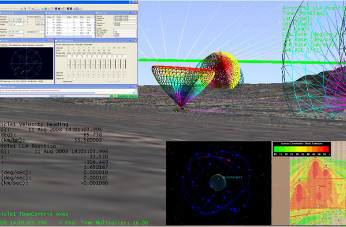
- Fully exercises GPS user equipment hardware and software under laboratory conditions using real-time simulation of GPS satellite signals, simulated and/or hardware-in-the-loop host vehicle aiding and communications systems.
- Simulates realistic operational conditions, including threat environments and security architecture extended functions.
- Designed to test "systems of systems," to allow testing of highly integrated navigation techniques, real-time precision weapon targeting and other applications of highly integrated platforms.
- The CIGTF Advanced Threat Simulator (CATS) incorporates a wide range of advanced antenna system models providing and extensive anti-jam mitigation and simulation tool.
Flight Testing
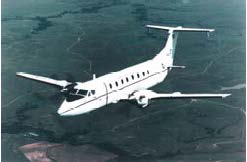
- Fully instrumented aircraft include the T-38C, C-12J, C-12D and UH-1 or a customer chosen platform.
- Provides low, medium and high dynamic operating environments for the system under test.
- Can test a wide range of INS, GPS and/or integrated GPS/INS navigation and guidance system configurations.
- Large customer payload area available.

Inertial Laboratory Testing
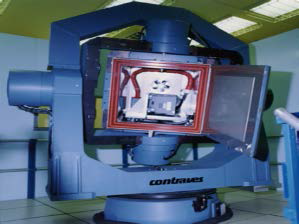
- Centrifuge testing provides sustained high accuracy accelerations for error identification and extraction.
- Multi-axis test tables simulate flight conditions in a thermally controlled environment.

Navigation Warfare (NAVWAR)
- Recognized leader in GPS NAVWAR threat testing.
- State-of-the-art NAVWAR modeling and simulation tools.
- Large stable of threat-representative GPS jammers; up to 200 kW ERP simultaneously on L1 and L2.
- Evaluate performance of antenna electronics in NAVWAR environment.
- Extensive experience obtaining NAVWAR frequency authorizations.
- Provide annual, low-cost and high-utilization "NAVFEST" test venue.
Reference Systems
- Includes a high accuracy validated truth reference source available in either a clear or NAVWAR environment.
- Medium and high-dynamic 3D position and velocity accuracies good to 0.35 m and 0.010 m/s.
- Sled track space-time accuracy good to < 1 mm and < 1 µs.
- Ultra-High Accuracy Reference System (UHARS), target for FY17 to provide an accuracy of 0.10 m and 0.005 m/s RMS per axis even in a NAVWAR environment.
Point of Contact
746th Test Squadron
575-679-2123 / DSN 349-2123
FAX: 575-679-2794
Email: 746ts.info@holloman.af.mil